SUMMARY OF CONTENTS
After nearly eight years of democratic breakdown at the hands of the military junta, State terrorism and total turnaround of the national economy from the production sectors and industry to finance and services. and after the Falklands war, restarting the way institutional normalization dala.
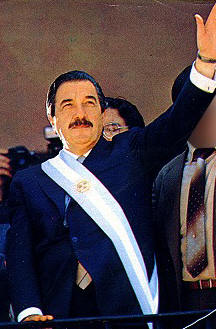
In the 1983 election, Raul Alfonsin won 51.7% of the vote against 40.1% of Italo Argentino Luder. becoming the first candidate to defeat a Peronist radical.
The UCR also established a historical precedent to get 128 of the 254 seats that made up the House of Representatives, 16 more than the PI and therefore the absolute majority.
Inside the Force made their PJ and small regional formations conservative. The UCR government only won seven of the twenty-three provinces. This imbalance between the electoral weight of the national UCR and PJ geographical predominance, more uniformly implemented in the provinces, was reflected in the Senate, where 46 members of Alfonsin's party conquered only 18 seats, ie the minority.
During his campaign, Alfonsin was the candidate who most clearly talked about the future role of armed forces as an institution has subordinate to civilian authority, and in particular to him as Commander in Chief in his capacity as President of the Nation . Third proposed cutting the military budget and the counter-insurgency police remained in the hands leaves within the framework of law and respect for human rights.
also announced a reorganization of the unions, until then Peronist majority-owned. He said the aim was to democratize these institutions and make them union representing most workers. I pointed to the existence of a military pact-union that threatened democracy in Argentina and proposed thwart just assumed the presidency of a nation.
The electorate turned to the radical proposal for promises of economic progress, but because Alfonsín burst as the guarantee of institutional normalization where Freedom, peace, democracy and respect for individual rights and human rights, mutilated by the military junta-expressing justice and modernity.
Alfonsin's government was marked by three key events or issues related to the military theme: the trial of the former commanders, human rights policy and the military problem in itself, not just issues with in-house forces, but also with the various uprisings that had to face.
The military dictatorship had caused a deep split between the company and their armed forces. This was the resounding failure of the National Reorganization Process to solve the grave problems facing the country, state terrorism, implanted Armed Forces and the methods used to dispose of anyone who did not share their plans, and finally, to defeat in the Falklands War and the events that had occurred there.
Alfonsín knew I could not lay solid foundations for the future unless the matter was settled civil-military why his campaign said in some ideas from which to overcome it. On the one hand, eliminating the post of commander in chief of any weapons. The military hierarchy would be completed in the office of Chief do Estado Mayor and the Commander in Chief who would be the Constitution: the President of the Nation.
On the other hand, proposed to reject any self-amnesty, declaring void any law that would amend action taken by the military government, but at the same time recognizing that there were different responsibilities between the performers: the responsibility of the decision maker to act as he did, other responsibility other than those ultimately committed excesses in the crackdown, and quite another for those who did nothing but follow orders, the theory of the three levels was expressed by Alfonsin in a speech in Ferro's court during the campaign of 1983. Finally, we seek to decrease the budget of the Armed Forces. That is, intended to have the Armed Forces of the Nation under the Constitution democracy.
Immediately after taking office, Alfonsin began to realize some of the points he had set earlier. Just three days after taking office, gives the decrees 167 and 158. The first stated the need to prosecute drivers of armed groups like the Montoneros and the People's Revolutionary Army (ERP). The second ordered the trial of the former commanders who made up as three military juntas to the Supreme Council of the armed forces for their role in the killings, torture and detention illegal perpetrated between 1976 and 1983 inspired by the National Security Doctrine.
also started restructuring the Ministry of Defence, in order to transform it into an instrument through which democratic government could effectively control redefensa sector and through him to the military.
The Trial of the Boards would have the contribution of research conducted by the National Commission on Disappeared Persons Conadep). Alfonsin called by the December 15, 1983 and whose presidency was given to writer Ernesto Sabato. His goal was to intervene in clarifying of the facts surrounding the disappearance of people giving them authority to receive complaints and try and turn them after the justice. The report, which was later published under the title never was submitted to the President on 20 September 1984 and determined to do 8960 were forcibly disappeared during the dictatorship, while Amnesty International estimated the number of victims exceeded 16,000 Argentine organizations as Madres de Plaza May spoke of 30,000 dead or missing affected.
The trial of former soldiers began orally and on 22 April l985yconcluyó to the sentence Federal Court in December of that year, the lieutenant generals and former Presidents Jorge Rafael Videla Facto and Roberto Eduardo Viola, Brigadier General Orlando Ramon Agosti and Admirals Emilio Eduardo Massera, and Armando Lambruschini were charged and sentenced for crimes of murder, deprivation do illegal freedom and application of torture on detainees. They were also convicted and 1 Supreme Council as the armed forces, Lieutenant General Leopoldo Fortunato Galtieri, Brigadier General Basilio Lami Dozo and Admiral Jorge Isaac Anaya (acquitted by the civil courts in the previous process "Although this experience trial created a historical precedent not only for Argentina, but also to Latin America, where experiences are always talking coups gone unpunished, certain sectors of society felt that penalties were inadequate given also many defendants had been acquitted of m000rrango.
then, and to close the chapter on crimes committed during the dictatorship, Alfonsin sent Congress the bill that became known as Punto Final and it was approved on December 23, 1986. Under this law was extinguished any criminal action against civilians and / or military had not been charged for crimes committed in counter-insurgency operations within a specified period of time (just the 23102/87). La Ley de Punto Final rejection occurred and discomfort in important sectors of civil society but also within the military sectors.
The April 16, 1987 Lieutenant Colonel Aldo Rico and a group accompanying him! known as the carapintadas, mutinied at the School of Infantry at Campo de Mayo resisting the subpoena that faith made by Mayor Justice Ernesto Guillermo Barreiro (XIV refuge in the Airborne Infantry Regiment, La Calera! Cordoba, also declared in rebellion) . The rebels asked for an end to the campaign of aggression do the media against the armed forces, a budget increase for those forces! the election of a new Chief of Staff of the Army of five candidates they propose and exoneration for all those who participated in the events that were happening. Meanwhile across the country, people rushed to the streets and squares to express their support for the constitutional government and its repudiation of the attitude of the carapintadas.
After several attempts to resolve the crisis was the same Alfonsin who had to be present in Campo de Mayo and to make Aldo Rico surrender. This was quickly communicated to people gathered in the Plaza de Mayo.
Immediately there was the replacement of General Hector Rios Ereñú as Chief of Staff by General Jose Dante Caridi. A few days after Alfonsin sent Congress the draft of Due Obedience Law enacted on 08/06/1987) which only supported the prosecution of those who were performing above the rank of brigadier, ie! those who had given orders Yque had received operational capacity to implement them. There was one exception: it was the case of crimes of substitution marital and child abduction and concealment.
laws of Punto Final and Due Obedience laid bare, to society, the fragility of constitutional government against pressures from certain sectors of the military-particularly the Army to conclude that the persecution of their comrades weapons.
Other military uprisings followed. Monte Caseros in Corrientes province, between 16 and January 1988 Alda Rico turned to revolt, rejecting the extension of his arrest by the events of Holy Week.
This time the forces loyal to "redirect the situation. It was the first clash between the military, after the 'blue and red in 1962. On 4 June the same year Colonel Mohamed Ah Seineldin was the leader of a new uprising! This is in Villa Martelli. They sought to restore honor and dignity of staff and the military, claiming the war against subversion, the proceedings in the Falklands War and reach a broad amnesty. The rebellion was quickly quelled.
In 1988, Japan enacted the National Defense Law (Issue 23554), which establishes the legal, organizational and functional for the preparation, execution and control of National Defense, fixing his aims and differences with the Law of Homeland Security.
But the problem of human rights and the troubled relationship with the Armed Forces was not and 1 radical government only had to face. Economic power, formed by large international financial groups and the major local economic groups had been able to control the entire production process and financial support based on the exploitation of workers and the subordination of the State to its interests. A 20% monthly inflation, external debt was around 45,000 million dollars, 70% of it had been made by private groups and nationalized by the then President Central Bank! Domingo Felipe Cavallo. in 1932 - and an unemployment rate which stood at 7%. were as consequences that the dictatorship had left in the economic field. To alleviate the situation of those families who could not meet their basic needs was launched the National Food Plan (PAN).
One of the ideas of Alfonsin was to terminate the General Labour Confederation
In June 1085 Austral Plan was announced. Our currency changed the name of the Argentine peso to south. The Southern equivalent to 1,000 pesos and was born trading at a fixed rate of southern BO cents per dollar.
The measures included in the plan were: control of prices of goods and public utility rates, wage freeze and no monetary issue. It was intended to stop inflation and then growing 1% daily.
Many of these measures were conditions that the IMF demanded to continue the negotiations came to fruition when Alfonsin signed an agreement with that entity re - spreading payment of external debt falling due this year and the grant an additional credit of $ 4,200 million, although in the first months of his government promoted the creation of a legislative commission to establish the amount of legitimate debt and he tried not to negotiate the payment of it only with the IMF, going to the World Bank, Paris Club. Inter-American Development Bank (IDB) and private banking. The initial success of the Austral Plan is reflected in the legislative elections of November 1985. The UCR strengthened its majority in the Chamber of Deputies keeping intact its 128 seats. PJ, however, reduced its representation to 101 seats. Radicalism also won 17 of the 23 governorates, including the Federal Capital. The win gave indications that associate-ing continued trust in the ability to address cough Alfonsin big problems facing the Argentine people.
But at the end of 986, the Austral Plan showed signs of exhaustion. The Southern began to lose value against the dollar heavily in e 'market changed. Inflation climbed back while the recession and social unrest grew more and more. Given this situation, I opted for the abandonment of strict controls cough and economic liberalization. This meant a break with the semi-closed economy model in place for half a century and the opening of markets to foreign products, accompanied by the reform. Such a policy was framed in the changes taking place internationally. Both England and the U.S. led to a series of reforms in which the state no longer intervene in the economic and social problems. Thus, a wave of privatization, reduction of social benefits of public employment and opened the way for neoliberalism.
In August 1986 the Chamber of Deputies began to try and adopted in a few days the Divorce Bill. The process was slower in the Senate, but after some modifications, on 3 June 1987, the divorce is legal in Argentina to
During his rule. Alfonsin sought to give impetus to foreign policy, abandoned by the dictatorship and Foreign Minister Dante Caputo was responsible for that task. Chile was resolved the conflict over border demarcation the Beagle Channel. from which almost started a war in 1978 and that on the eve of the 1983 election, created new tensions. With mediation from the Vatican, the two southern countries first signed in 1984 a declaration of peace and brotherhood and then agree on and 1 canal, which was ratified by Argentina society with a favorable devotees in a referendum called for that effect. In 1985 the Vatican initialed a bilateral treaty, in relation to negotiations with the United Kingdom over the Falkland Islands, London only won the resumption of bilateral dialogue, excluding regard as the sovereignty of islands.
Alfonsin also initiated talks to achieve regional integration with Brazil and Uruguay, signed in 1988, along with the leaders of both countries, the Treaty on Integration, Cooperation and Development, which would be the cornerstone of the Southern Common Market ( MERCOSUR). The treaty pledged the creation of a common trade area in ten years, by eliminating leave and non-tariff barriers and harmonization of trade policies.
In the 80 Argentine cinema opened its doors to the desire for change. The directors do not exiles had turned to cinema advertising as an alternative to work and then, with the return to democracy, implicitly establishing a new form of filmmaking, this 1 this case Pino Solanas and Luis Puenzo. During the Alfonsin government. the principal stakeholders in the culture were occupied by figures and personalities related to the field, such as actor Luis Brandoni in the presidential advisory issues of culture, the writer Pacho O'Donnell, secretary do Culture of the Municipality of Buenos Aires, Carlos Gorostiza in the Ministry of Culture of the Nation! Miguel Angel Merellano in ATC. All these basic transformations encouraged [a real idea of \u200b\u200bexchange, but even so, the reproof of the films remained in effect. For this reason, Congress voted to set up 23,052 law abolishing film censorship for nearly 30 years had thwarted the public's freedom and creativity of the authors. In 1984, there were 24 premieres. The first democracy was Camila, Maria Luisa Bemberg. From that moment! many films try to reflect through their stories you years of military dictatorship. With the return to democracy, little by little, the various art and artists who had been censored or exiled, could translate their ideas freely and try to rebuild the Argentine cultural heritage. People were eager to read, watch and listen. And the artists (filmmakers, musicians, writers) avid do show and sing true.
By 1986, Alfonsin announced an ambitious project to establish a 'Second Republics. Fa included the addition of a prime minister set out the possibility of a second consecutive presidential term, administrative reforms and the move of the Federal Capital of the province of Black River in the city of Viedma. The idea was evaluated as inappropriate for large parle public opinion, which I also considered that the intention was to hide the harsh reality that attended: 1986 ended with a cumulative inflation of 82% and reached in 1987 to 175%.
mid-1987 the government officially declared defunct Southern Plan (although the coins he gave his name continued to operate> and announced a new package of measures that would attract the support of IMF credit by another stand- by. The attack on inflation and fiscal deficits and abroad. It also established strict guidelines in relation to the official exchange rate of the dollar, wages, taxes and utility rates.
The application of these measures, which caused a large decrease in the purchasing power of some social sectors coupled with the lukewarm response to the military problem, the impossibility of dealing with union issues and others, affect the results of the elections of September 1987. They also influenced the internal cleansing process was within the l, known as the Peronist Renovation, led by Antonio Cafiero and Manuel de la Sota. In the election of national deputies PJ 1987, won 41.5% of the vote compared to 37.3% of the UCR, in the provincial radicals remained only the governor of Cordoba and Black River near the Federal Capital.
These election results and the worsening economic situation led the government to abandon some projects and rethink its economic policy. In August 1988, launched the Spring Plan (Program Fa economic recovery and sustained growth>. I was focused, once again, to contain the rising inflation through price controls as public utility rates and a freeze on state salaries . It included exchange and price control, and negotiation with the labor movement. the Industrial Union of Argentina and the Chamber of Commerce. remained outside the negotiating Argentine Rural Confederation. the Agrarian Federation, Rural Society and Coninagro.
1989 would be a year adverse to the government:
• The drought affected crops and energy provision do,
• THE takeover 3 Infantry Regiment of La Tablada carried out by members of Movement for All Homeland. His recovery-charge of the police and the army-led balance of 39 dead and dark murky explanations for the motives and connections of the action as he called ultra-left "government" and also on how the issue was resolved ,
uncontrolled • Raise interest rates, depletion of the Central Bank to try to maintain the value of a cheese southern increasingly depreciated against the dollar.
• Strike Morea produced by the major economic groups to withdraw their deposits from banks, exports produced by foreign withholding and delaying the payment of taxes.
The campaign for the presidential elections of May 14, 1989 was carried out in this market. The situation was becoming mere manageable: hyperinflation, loss of purchasing power of wages, prices redial, compulsive buying of dollars by speculators.
In the elections, the PJ candidate, Carlos Saul Menem, Eduardo Angeloz beat. UCR, with 47% of the vote, in the midst of looting at supermarkets. the social situation was becoming untenable for Alfonsin. Juan Jesus Rodriguez Sourrouille replaced as Minister of Economy. May 30 declared a state of siege and emergency economic measures. Began to sound the word ungovernable. Alfonsin was removed before the government, without being able to fulfill its promise of recovery 'order. It was the first time in a long time that a constitutionally elected civilian government and was succeeded by another of equal status. His presidency was restored and opened the door to the consolidation of democracy in the country and broke the international isolation, but could not achieve positive growth, external debt and wages had risen dramatically decreased, suggesting optimistic Menem came follow me, salariazo productive revolution, with recession in Argentina 6% of GDP, external debt of 63,000 million dollars and hyperinflation close to 5000% per annum.


0 comments:
Post a Comment